
Hotel Guest Data in 8 Clouds: The GDPR Liability Risk
Your PMS vendor's breach is your hotel's GDPR fine. Guest data sits across 8 clouds. The Marriott case proved how exposure compounds. What to audit now.

Hotel Guest Data in 8 Clouds: The GDPR Liability Risk
Your Property Management System vendor gets breached. Your guests' passport numbers, booking history, and travel patterns are exposed. The fine arrives in your name, not the vendor's. Their contract caps their exposure at routine service fees. Yours is uncapped under European law.
This is not a hypothetical. This is what the Marriott case proved, and it is what GDPR regulators have been quietly building enforcement muscle around for the past five years. The question is no longer whether your hotel can be held liable for a vendor's breach. The question is what you will hand a regulator when they ask where your guest data lives, and whether the answer reflects a coherent trust infrastructure for hotels or a fragmented set of vendor contracts.
Are hotels liable when their PMS vendor gets breached?
Yes, and the legal reasoning is settled. Under GDPR Article 28 data processor obligations, the hotel is the data controller and the vendor is the data processor. The controller carries the primary obligation to ensure that processors deploy appropriate technical and organisational measures to protect personal data. When a vendor fails, the regulator does not write to the vendor first. The regulator writes to the controller. That is the hotel.
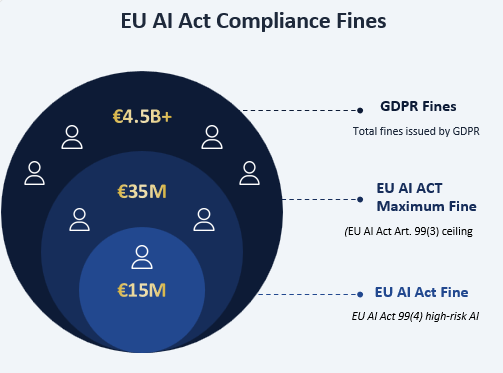
GDPR maximum penalties under Article 83 reach €20 million or 4 percent of global annual turnover, whichever is higher (Regulation (EU) 2016/679, Article 83). EU AI Act compliance for hotels adds a second regime layered on top, with separate ceilings of €35 million or 7 percent of turnover for prohibited practices under Article 5, and €15 million or 3 percent for high-risk AI obligations under Annex III (Regulation (EU) 2024/1689 [eur-lex.europa.eu]).
These regimes are independent. A hotel can be exposed under both for the same incident if AI processing was involved.
How many systems hold a single guest's data in a typical hotel?
At least eight, in most 4 to 5 star European properties. Each one is a contract, a data processing agreement, a credentialed access path, and an attack surface:
- Property Management System vendor cloud
- Revenue Management System servers
- Channel manager database
- Online Travel Agencies (Booking, Expedia, Agoda, regional players)
- Guest messaging platform
- Customer Relationship Management system
- Payment processor
- AI chatbot provider, often training on your conversations under terms most general counsels have not read
This is the data diaspora. It is the architectural condition GDPR was written to constrain, and it is the precise condition most hotels operate under. Each link in the chain holds a copy of guest data the controller cannot directly inspect, audit in real time, or revoke at speed when a regulator asks for proof of access logs.
What did the Marriott GDPR fine actually prove?
The Marriott Starwood breach ran for approximately four years inside reservation systems before discovery. By the time the company disclosed in 2018, around 339 million guest records had been exfiltrated. The UK Information Commissioner's Office issued an initial penalty notice of £99 million, ultimately reduced to £18.4 million after representations (ICO Marriott penalty notice, October 2020).
The ICO's reasoning sat on a single phrase. Marriott had failed to deploy appropriate technical and organisational measures, the same language Article 32 of GDPR uses verbatim. Translated for an operator: Marriott did not know where their data was, who had access, or that it was being copied. The breach did not begin at Marriott. It began in a Starwood legacy system acquired and never properly audited. Most cloud vendors carry legacy systems too. Most hotels have not asked which ones. Industry breach reports consistently show that the average dwell time between intrusion and detection runs into the hundreds of days across sectors (IBM Cost of a Data Breach Report).
Can architecture replace policy for GDPR compliance?
Policy is what a hotel writes in a data processing agreement. Architecture is where the data physically lives and what controls the encryption keys. The two are not interchangeable. Regulators read policies but enforce against architecture, because policies do not break or get breached. Systems do.
There is an alternative architectural posture that GDPR rewards explicitly under Article 25, data protection by designand by default. When guest personal data stays on-premise inside the building, encrypted with keys the hotel controls, the data processor question collapses for that data. There is no third party to audit at the moment a regulator arrives. There is no transfer beyond the property to dispute under Chapter V. There is one location, one set of keys, one chain of custody.
This is what trust infrastructure means in operational terms. Cloud vendors promise compliance. The hotel still carries the fine. On-premise architecture removes the gap between promise and proof. Privacy is not a policy. It is architecture.
What should General Counsel, CTOs, and General Managers do this quarter?
If you are a General Counsel, the audit window opens with a single document: the data processing agreement of your PMS vendor. Read the liability cap clause. Read the breach notification timeline clause. Read the audit rights clause. If any of those three clauses surprise you, the architectural conversation cannot wait until the next renewal.
If you are a Chief Technology Officer or IT Director, the procurement question has shifted. The relevant filter is no longer integration depth or feature count. It is whether the architecture lets you produce, on demand, a complete and tamper-evident record of what data was processed, by which system, on what date. Cloud topologies typically cannot produce that record at tenant level. The AUVA-X on-premise architecture is built around producing exactly this evidence by default.
If you are a General Manager or owner, the regulatory window is not five years out. GDPR enforcement intensified across hospitality from 2025 onward, and the EU AI Act enforcement timeline concentrates procurement urgency through 2026 and 2027. Properties that act inside the next four to six quarters can deploy compliant infrastructure ahead of the audit cycle. Properties that wait will procure under regulator pressure, which is the worst commercial position to negotiate from.
When regulators come asking, you will either have answers or you will have a vendor list.
Frequently Asked Questions
GDPR fines reach up to €20 million or 4 percent of global annual turnover, whichever is higher. The penalty applies to the data controller, which in hospitality is the hotel itself, under Article 83 of Regulation (EU) 2016/679. The ceiling applies regardless of whether the breach occurred on the hotel's own systems or on a vendor's cloud infrastructure.
Yes. Under GDPR Article 28, the hotel is the data controller and the PMS vendor is the data processor. The controller carries the primary obligation to ensure that processors deploy appropriate technical and organisational measures. When regulators investigate a breach at the processor, the controller's name appears on the penalty notice. Vendor contracts that cap the processor's liability do not transfer regulatory exposure away from the hotel.
The UK Information Commissioner's Office initially proposed a £99 million fine in July 2019, ultimately reduced to £18.4 million in October 2020 after Marriott's representations. Approximately 339 million guest records were exposed during a four-year breach period inside Starwood's reservation systems, which Marriott had acquired in 2016 and not fully audited.
At least eight in most 4 to 5 star European properties: the PMS vendor's cloud, RMS servers, channel manager database, OTAs, guest messaging platform, CRM, payment processor, and AI chatbot provider. Each system carries a separate data processing agreement, a separate access path, and a separate audit obligation under GDPR Article 28.
Article 28 requires hotels to engage only data processors that provide sufficient guarantees of appropriate technical and organisational measures. Hotels must hold a written data processing agreement with each vendor, specifying processing purposes, duration, security obligations, breach notification timelines, and audit rights. Failure to maintain Article 28 documentation is itself a separately fineable offence.
No, but it materially simplifies compliance. Article 25 of GDPR rewards data protection by design and by default, and on-premise architectures where guest data stays inside the property, encrypted with keys the hotel controls, collapse the data processor question for that data. There is no third party to audit and no cross-border transfer to defend at the moment a regulator arrives.
Yes, when AI systems are involved in processing the breached data. The EU AI Act creates fine regimes layered on top of GDPR: up to €35 million or 7 percent of global turnover for prohibited practices under Article 5, and a separate ceiling of €15 million or 3 percent for high-risk AI obligations under Annex III. A single incident involving AI-driven pricing, scheduling, or guest profiling can trigger exposure under both GDPR and the EU AI Act simultaneously.
Conclusion: Architecture Decides Outcomes
GDPR was written to constrain a world where personal data lives in many places. Five years of enforcement have shown that hotels operating with eight clouds in their data supply chain cannot produce, on demand, the kind of evidence regulators expect: who accessed which record, when, under what authority, and on what hardware-signed log. The Marriott case did not introduce that gap. It exposed it.
The architectural answer is not new. Article 25 of GDPR has rewarded data protection by design since 2018. What is new is the procurement environment around it. EU AI Act enforcement compounds GDPR exposure for any property using AI in pricing, scheduling, or guest profiling, which now describes most 4 to 5 star European hotels. The window to deploy compliant infrastructure ahead of an audit cycle, rather than under one, sits inside the next four to six quarters.
When the regulator's letter arrives, the hotel that controls its own data hands over a complete, hardware-signed record. The hotel that does not hands over a list of vendors and waits to learn which one was breached. The two outcomes are written before the letter is sent. They are written by the architecture, not the policy.