
Wrapping is Not Architecture: Why Hotel AI Agent Stacks Cannot Hold
Wrapping a cloud LLM API is not architecture. It is procurement. The eight structural failures killing hospitality AI agent stacks in 2026.

Wrapping is Not Architecture: Why Hotel AI Agent Stacks Cannot Hold
There is a category emerging on LinkedIn this quarter called agentic AI infrastructure for hospitality. It is neither agentic nor infrastructure.
Strip the launch deck, and the underlying pattern is almost always the same: a thin orchestration script that calls a cloud LLM API, wraps the response in a hospitality workflow, exposes it through a SaaS dashboard, and gets sold per property as an "AI agent for hotels." The pitch sounds architectural. The deliverable is procurement. The hotel ends up with a subscription dependency on someone else's foundation model, on someone else's compute, governed by someone else's terms of service, priced by someone else's per-token meter, audited by someone else's SOC 2 attestation, and exposed to whatever regulatory regime applies wherever that someone else's data centre happens to sit.
Wrapping a cloud LLM API is not architecture. It is procurement. And the agent stacks announcing themselves this quarter will not survive contact with the EU AI Act in 90 days, with the next cloud outage, or with the procurement budget at operational scale. This sits inside the broader trust infrastructure for hotels argument the regulatory environment is now pulling forward.
What hotel AI agent stacks actually are
The pattern repeats across the wave of "AI agent" companies pitching hotels this year. A foundation model API running on someone else's servers. An orchestration framework or multi-agent orchestrator, whether LangChain-class libraries, MCP-wrapper layers, or proprietary equivalents. A vertical wrapper for hospitality, with prompts tuned to hotel use cases. A SaaS dashboard with per-property licensing.
What is being sold is the wrapper. What is being delivered is the dependency chain underneath it.
This is not a critique of the foundation models. They are remarkable tools. It is a critique of treating an API call as if it were a system, treating a prompt as if it were code, and treating a SaaS subscription as if it were infrastructure.
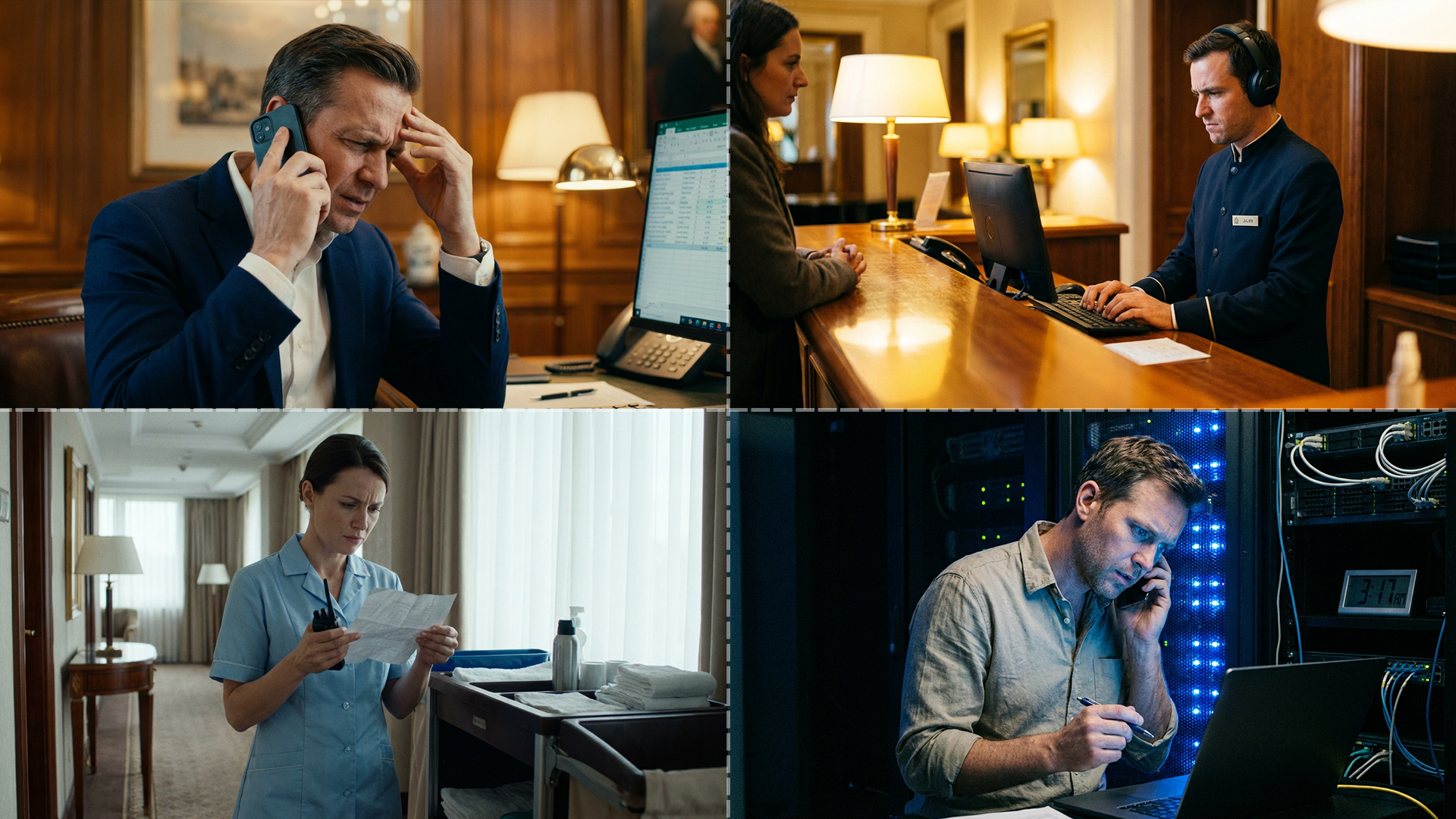
The eight structural failures of agent-stack architecture
- Latency tax. Operational decisions route through network round-trips to a foundation model. Hundreds of milliseconds minimum, often seconds. Real-time pricing, fraud detection, and anomaly response die in the round-trip. The decision is already late by the time it leaves the building.
- Sovereignty failure. Every prompt carries guest data, employee data, operational data, business logic. Under GDPR Article 28 the hotel remains the data controller for everything sent to the API. The hotel guest data sovereignty exposure cuts both ways: through the cloud PMS and through the agent stack on top of it.
- Continuity failure. When the foundation model API goes down, the agent stack goes dark. Hotels using cloud-API agents now carry two cascading single points of failure: the underlying cloud platform and the model API on top of it. The hotel cloud outage continuity risk now hits twice.
- Audit failure. A JSON response from a foundation model is not court-admissible evidence. Reconstructing what the model decided yesterday from cached prompts, API timestamps, and orchestration logs is reconstruction, not record-keeping. Article 12 of the EU AI Act requires automatic record-keeping of high-risk AI decisions. API logs do not satisfy this.
- Composition failure. Stacking five agents that each call an API does not make a system. It makes a fragility chain. Each link multiplies failure modes: latency adds, prompt-injection vectors add, hallucination compounds, error handling fragments. Multi-agent orchestration is not capability multiplied. It is fragility multiplied.
- Cost failure at scale. Per-token pricing scales linearly with operational volume. A 200-room property running thousands of pricing, scheduling, personalisation, and anomaly decisions per day breaks the unit economics. The pricing model that works for chatbot demos collapses at production load. Hospitality groups running hundreds of properties hit this wall well before they hit the procurement committee.
- No native fusion. The agent reads from one cloud, decides in another, executes in a third, and the audit trail lives in a fourth. The architecture is fragmented before the first guest checks in. Native fusion, the property of having decisions, data, and execution sharing the same memory, is structurally absent.
- Identity confusion. "AI agent for hotels" is a feature. It is not a category. Real categories own their compute, control their data, and survive the failure of any single upstream provider. Subscriptions are not categories.
Request the AUVA-X agent-stack diagnostic for your property.
What architecture actually looks like
The architectural alternative is not a different agent. It is a different system. When the AI is native to the operational stack, when it shares memory with the PMS, the channel manager, the energy management layer, and the building security system, when decisions are signed at hardware level at the moment of decision and stored in a local immutable ledger, when the entire stack runs inside the building on the property's own hardware, the eight failure modes collapse.
The AUVA-X on-premise architecture is built that way because the law and the operational reality both required it. Hardware-signed at source. Local. Native fusion of decision and data. Court-admissible. Network-independent. Designed to satisfy Article 15(4) by composition, not by policy.
This is the difference between renting AI and owning the architecture that runs it.
What the next 90 days expose
The EU AI Act high-risk obligations enter force on 2 August 2026 unless the Digital Omnibus is formally adopted before that date. The April 28 trilogue collapsed. The follow-up is scheduled for around 13 May. Hotels running workforce-management AI on a cloud-API agent stack now have to defend a deployment in front of national supervisors that asks the question: what evidence does the system produce at the moment of decision, signed by what hardware, stored where?
Cloud-API agent stacks cannot answer that question with a record. They can only answer it with a reconstruction. Article 15(4) prefers records. The full EU AI Act 90-day picture sits behind that question.
Frequently Asked Questions
A typical hotel AI agent stack combines a cloud foundation model API, an orchestration framework or multi-agent orchestrator, a hospitality-specific wrapper, and a SaaS dashboard with per-property licensing. The agent processes prompts containing hotel data, returns recommendations or decisions, and surfaces them through a dashboard. The compute and the model are rented from a third-party provider.
An AI agent is a workflow that calls a foundation model and processes the response. AI architecture is the system in which AI decisions are made, signed, stored, executed, and audited. Architecture owns the compute, the data, and the audit trail. Agents typically rent all three.
Cloud-API LLM wrappers face significant compliance gaps under the EU AI Act, particularly Article 15(4) on resilience and Article 12 on record-keeping. API responses are not hardware-signed, do not survive network outages, and rely on the upstream provider for continuity. Once on-premise alternatives are commercially available, cloud-only deployments are sub-maximum by definition.
Multi-agent orchestrators stack independent agent calls into chains. Each link adds latency, prompt-injection risk, hallucination compounding, and error-handling complexity. The aggregate failure surface scales with the number of agents in the chain. For operational use cases requiring real-time decisions, this fragility is structural.
Native-fusion AI integrates AI decision-making directly into the operational system, sharing memory with the PMS, channel manager, and other building systems. Decisions, data, and execution sit in the same physical environment, on the same hardware, with one audit trail. AUVA-X delivers native-fusion AI on-premise inside the property.
Yes. On-premise edge architectures process AI decisions locally, on hardware physically present in the property. The pricing model, the recommendation engine, the workforce optimisation layer, and the audit trail all run inside the building. External systems sync when connectivity returns. The hotel never depends on a third-party API for operational continuity.
Per-token pricing scales linearly with operational volume. A property making thousands of decisions per day across pricing, scheduling, personalisation, and anomaly detection generates substantial token consumption. At hospitality group scale, the operational economics of cloud-API agent stacks break down well before they break the demo budget.
Three. Show us a hardware-signed audit record of a single AI decision the agent made. Demonstrate the agent surviving an eight-hour outage of the underlying foundation model API. Model the per-token cost at production volume across our property portfolio. Vendors who cannot answer all three are selling features, not architecture.
Conclusion: Architecture is What Survives
There is a difference between a feature and a category. A feature is something you ship in a release. A category is something you build a company around. AI agent stacks running on cloud LLM APIs are features. The companies announcing them this quarter will move on, get acquired, get repriced, get re-marketed, or close, and the hotels that bought their per-property licenses will be left negotiating with the next vendor in line.
Architecture is what survives. Hardware that sits inside the building. Compute that runs locally. Decisions that are signed at the moment they are made. Audit trails that survive the network. Native fusion of AI and operational data. The category that owns its compute is the category that survives the regulatory deadline, the cloud outage, the API repricing, and the next architectural shift after that one.
The agent stacks will fall. The architecture will not.
Cloud is someone else's house. We bring the brain home.